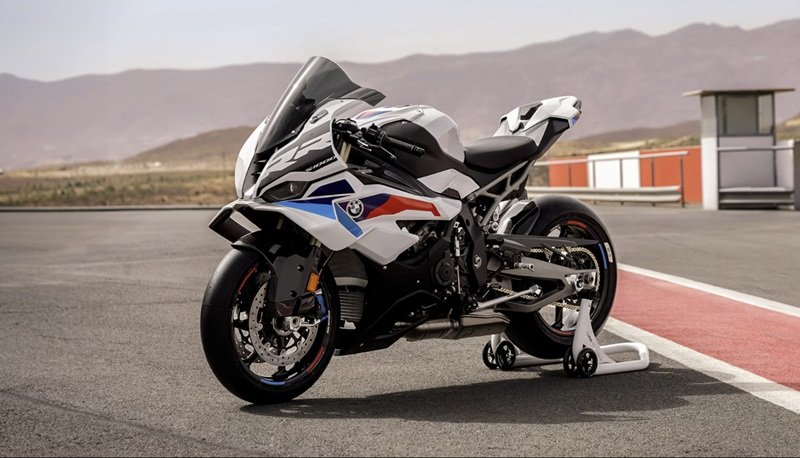
Six updates.
One bloodline.
BMW has reworked the S1000RR six times since it first turned a wheel in anger. None of the updates were cosmetic exercises — every one of them was driven by a rule book, a rival, or a racetrack. Pick an era below.
The provocation
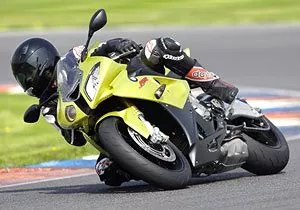
2009 – 2011 · First generationBMW had never sold a transverse inline-four motorcycle before this one. It built the S1000RR for one reason: to enter the 2009 Superbike World Championship, which requires manufacturers to sell a production version of anything they race. The street bike arrived first, in April 2008 as a reveal, with roughly 1,000 units built through 2009 to satisfy homologation rules before commercial production expanded properly in 2010.
It landed in a class dominated by Japanese and Italian manufacturers and immediately out-gunned all of them on paper: more peak power than any rival, standard electronic rider aids nobody else offered, and a price that undercut the competition. Riders and journalists either loved the aggressive, asymmetric double-headlight face or hated it — nobody was indifferent, which was rather the point.
What made it a first
First litre-class production superbike sold with standard Race ABS and Dynamic Traction Control (DTC) — rivals treated rider aids as optional extras, if they offered them at all.
First production motorcycle to offer an optional clutchless quickshifter, letting riders bang up through the gearbox at full throttle without touching the lever.
BMW Motorrad Motorsport entered WSBK from round one of 2009 with riders Troy Corser and Rubén Xaus, using the road bike as the homologation base.
Sharpening the tool
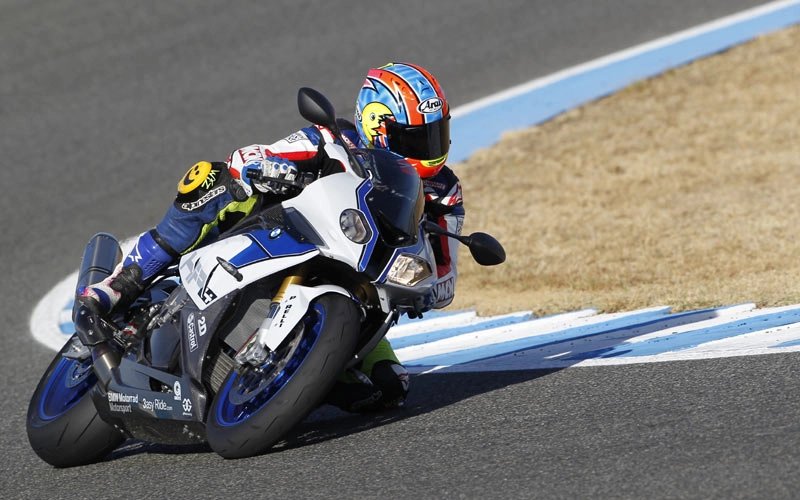
2012 – 2014 · First-generation updateThe 2012 revision kept the same 193 hp engine but went to work everywhere else: a reworked chassis, smoother traction-control calibration that softened how the bike cut power during a wheelie, and roughly 5 kg of weight trimmed from the base bike. It was the update that proved the S1000RR wasn't a one-shot flagship — BMW intended to keep developing it.
The real headline was a new variant: the HP4. It introduced BMW's semi-active Dynamic Damping Control (DDC) — electronically adjustable suspension that reads chassis behaviour in real time and firms up or softens the fork and shock accordingly — one of the earliest applications of that technology on a production superbike, alongside launch control and a pit-lane speed limiter.
The last, best version of the original
2015 – 2018 · First-generation finaleThe 2015 update was the most thorough refresh the original architecture ever received: revised bodywork, an updated engine making 199 hp, a lighter frame and swingarm, self-cancelling indicators, and — for the first time — the option of a full-colour TFT dash. A quickshifter that had once been a novelty was now fitted as standard. Euro4 compliance followed for 2017.
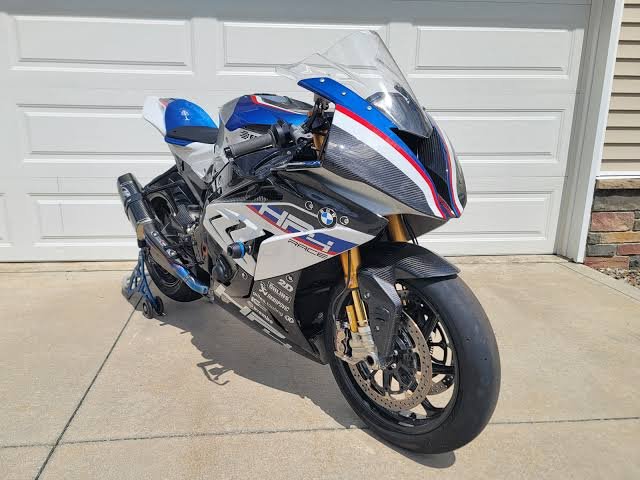
Then, at the very end of the line, BMW built something almost irrational: the HP4 Race. Limited to 750 units worldwide, it wrapped the S1000RR engine in a full carbon-fibre monocoque chassis and carbon wheels, stripped it to 146 kg, and sent it out the door as a track-only, non-homologated machine. It sold out globally and previewed the manufacturing techniques BMW would later bring to the M 1000 RR.
Starting over, on purpose
2019 – 2022 · Second generationTen years after launch, BMW threw away the old architecture and started again. Every major system changed: a completely new engine built around BMW's ShiftCam variable valve timing (see the Technology page), a chassis that uses the engine itself as a load-bearing structural member, and WSBK-derived "Full Floater Pro" rear suspension kinematics. The result was up to 207 hp, a wet weight down to 197 kg, and, for the first time in a decade, symmetrical LED headlights.
The electronics leapt forward too: a six-axis inertial measurement unit underpins lean-sensitive ABS Pro and traction control, a 6.5-inch full-colour TFT dash replaced analogue instruments, and buyers could choose from Rain, Road, Dynamic and Race modes as standard, with three further Race Pro settings on higher trims. BMW used the new platform to return to factory World Superbike racing in 2019, and to enter the FIM Endurance World Championship for the first time with a dedicated works team the same season.
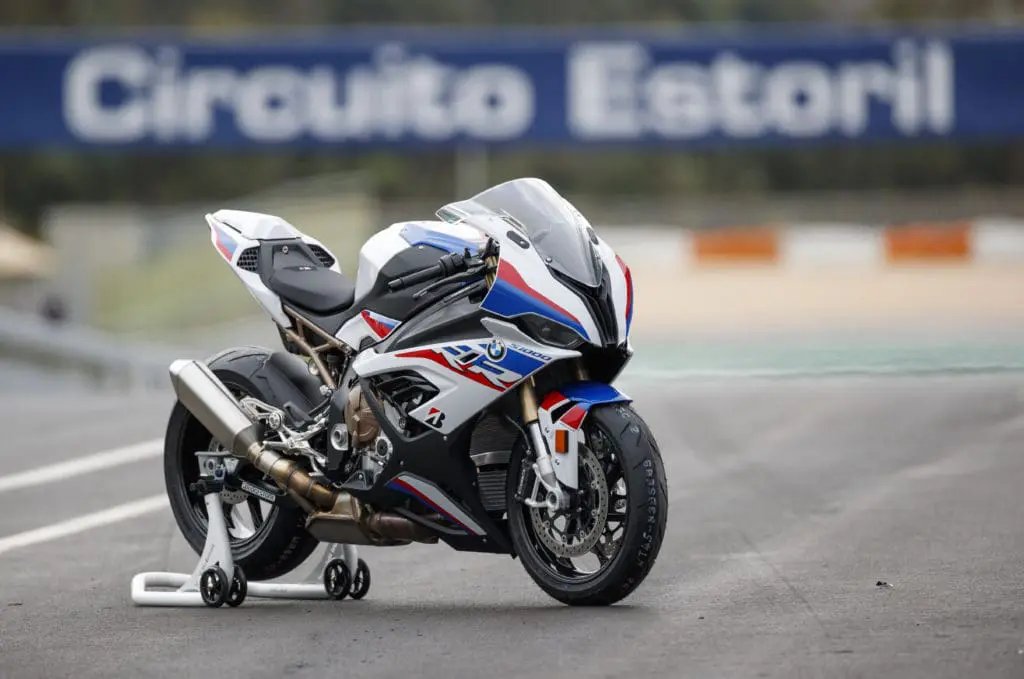
2021 aside: this is the platform that spawned the M 1000 RR, BMW's first-ever M-badged motorcycle. Read the full M 1000 RR story →
Trickle-down aerodynamics
2023 – 2024 · First major faceliftFour years is a long wait in the superbike class, and by 2022 BMW's own M 1000 RR had shown the rest of the range what it was missing. The 2023 update borrowed directly from it: front winglets became standard fitment on the base S1000RR for the first time, generating up to 10 kg (22 lb) of downforce and reducing how hard the traction control has to intervene under acceleration. A taller windscreen and a revised "Flex Frame" chassis — with more deliberate lateral flex and an adjustable swingarm pivot — arrived alongside.
The engine was retuned for a higher power peak (205 hp in US spec, 210 hp in most other markets), and BMW added a new Slide Control function that uses a steering-angle sensor to let riders dial in a controlled amount of rear-wheel slide on the way out of a corner, plus a Brake Slide Assist mode within ABS Pro. In 2024, this platform carried Toprak Razgatlıoğlu to BMW's first-ever WorldSBK riders' title — the full story is on the Racing page.
The current bike
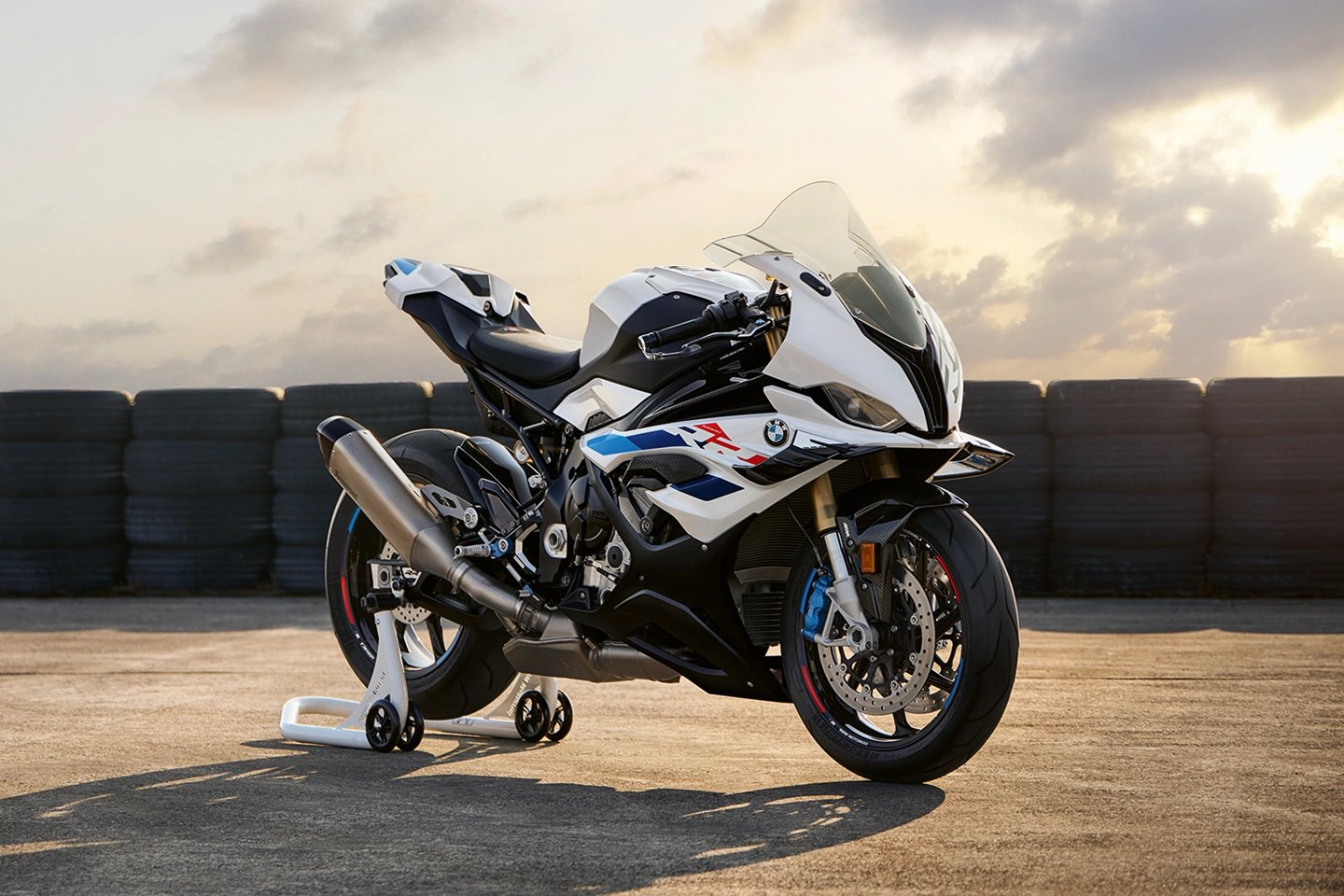
2025 – 2026 · Latest updateThe 2026 S1000RR — the model at the centre of this site — pushes the aerodynamics further again with redesigned "shark-gill" winglets that generate up to 37% more downforce at 186 mph than the previous generation, up to roughly 50 lb (22.7 kg) at the top of the speedometer. A new M Brake Duct front fender feeds cooling air to the front rotors, and an M Lightweight lithium-ion battery shaves a further 4.4 lb (2 kg).
The cylinder head's port geometry is now shared directly with the M 1000 RR, a new M Quick-Action throttle shortens the rider's wrist travel by 12 degrees, and BMW's Pro riding modes — previously an upgrade — are standard across the range. US-spec output holds at 205 hp at 13,000 rpm and 83 lb-ft at 11,000 rpm, with the platform now certified to Euro5+. In its home market, pricing starts at roughly $26,105 before options.